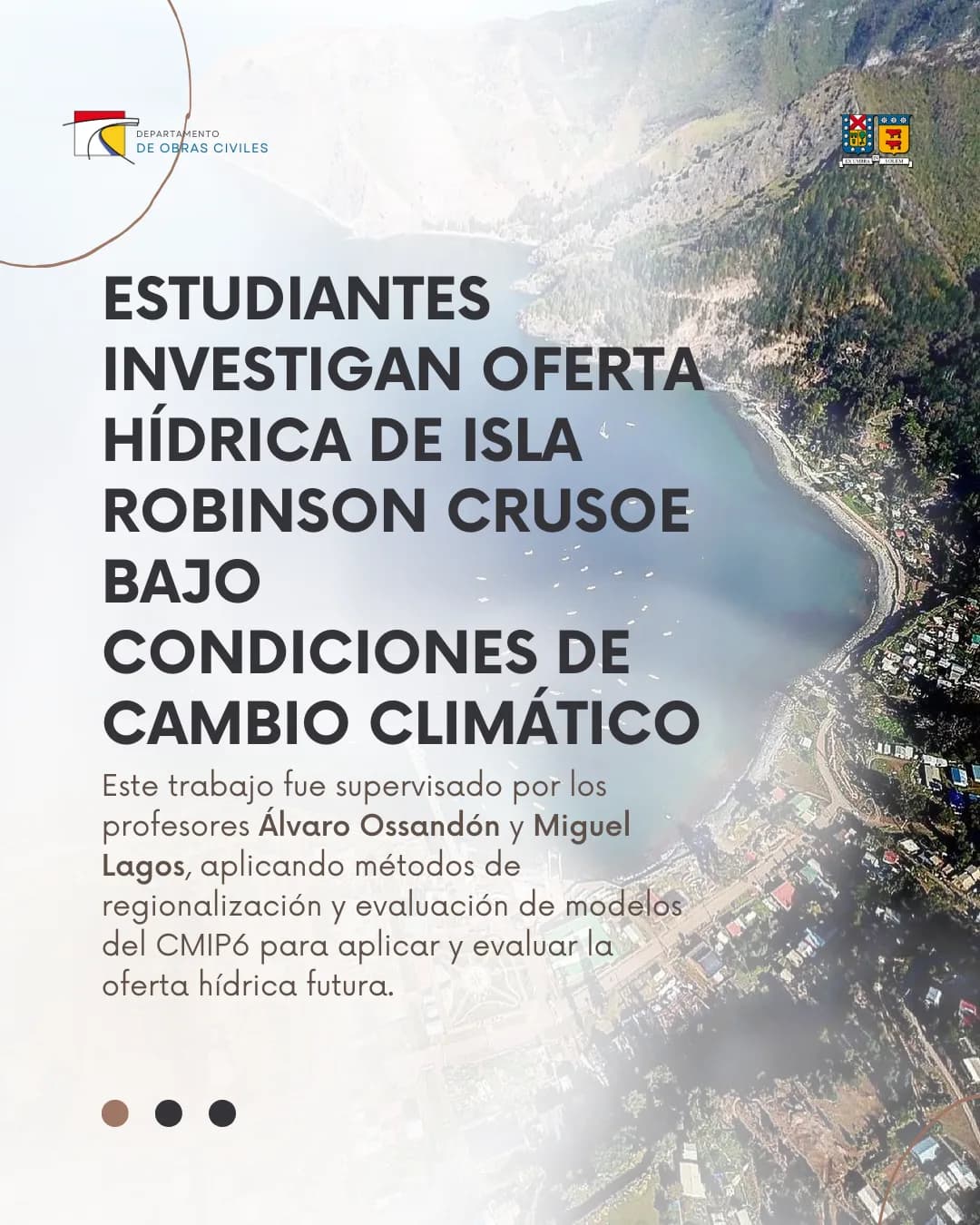
Students study the water supply of Robinson Crusoe Island under climate change
The results show lower water availability, which challenges the adaptation of the island and its residents to climate change.
Two USM Civil Engineering students, Javiera Carreño and Esteban Hinostroza, studied the water resources of Robinson Crusoe Island and how they could change under different climate change scenarios in their undergraduate theses.
The studies, carried out in 2025, responded to a request from the Rural Drinking Water Project of the Municipality of Juan Fernández, which asked the USM Department of Civil Engineering for help in 2024. The island's water comes from surface flows generated by rainfall during the year, because there are no other supply sources or regulation works to cover dry years.
Lower water supply
Esteban Hinostroza, a Civil Engineering student at the Casa Central campus in Valparaíso, built a hydrological model that represents runoff in gauged continental coastal basins.
For Álvaro Ossandón, faculty member in the Department of Civil Engineering and the student's advisor, "although the hydrological model was calibrated in a similar continental basin, the decline in streamflow is directly linked to a reduction in rainfall on the island. That is why, in addition to strengthening instrumentation and monitoring at the intakes, it is essential to assess alternative sources of drinking water, such as small-scale desalination, to strengthen the island's water security."
Climate change effects
Javiera Carreño, a Civil Engineering student at the San Joaquín campus, carried out a climate change study: she assessed how well global climate models represent the island's climate, in precipitation and temperature, to produce climate projections under moderate and extreme emission scenarios.
Miguel Lagos, faculty member in the Department of Civil Engineering and Carreño's advisor, says the research "used the latest methods for considering climate change in order to reduce the uncertainties associated with this type of model," to support decision making more concretely.
"With studies like these, the university fulfills its role of serving society, bringing scientific developments closer to people and directly helping the sectors most vulnerable to climate change," said Lagos, who added that the results of both theses will be sent to the Municipality of Juan Fernández.