
OpenUndergraduateMaster's
Origin of the moisture associated with extreme storms in South America
- Campus: Casa Central campus, San Joaquín campus
- Posted on
Motivation
Extreme events in South America depend on the moisture that the atmospheric circulation carries from the oceans and from other regions of the continent, such as the Amazon. Identifying the source regions of that moisture in each area helps explain the mechanisms behind extreme events and assess how they may respond to climate change. The group has already carried out this analysis in Chile; this thesis extends it to the continental scale.
Question: Where does the moisture associated with extreme storms in the different regions of South America come from? In particular:
- How much moisture comes from the ocean and how much from the continent, such as the Amazon, in each region and season?
- Do the sources change with the system behind the storm?
- Does the moisture travel from far away, or is it taken up in the last few days before the event?
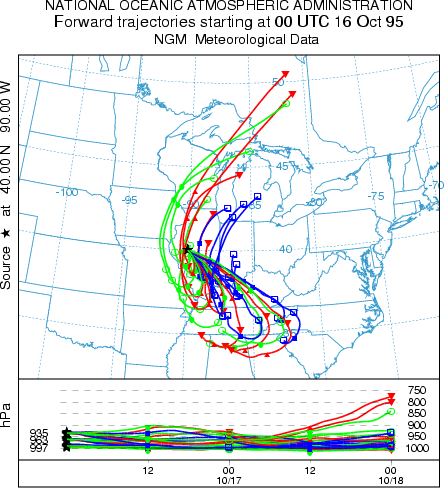
What you will do
- Compile and quality-control historical precipitation records from stations in several South American countries.
- Identify the extreme storms in each region from those records.
- Compute Lagrangian back-trajectories of air parcels for each event with HYSPLIT (opens in a new tab), NOAA's model, driven by atmospheric reanalysis.
- Use the Sodemann method to estimate how much each uptake region contributes, from changes in specific humidity along the trajectories.
- Cluster the trajectories and compare moisture sources across regions, seasons and storm types.
Requirements
Programming in Python or R (or the will to learn it) and reading in English.
Reading to get started
- Mudiar, D., Rondanelli, R., Valenzuela, R. A. and Garreaud, R. D. (2024). Unraveling the dynamics of moisture transport during atmospheric rivers producing rainfall in the Southern Andes. Geophysical Research Letters, 51, e2024GL108664. doi:10.1029/2024GL108664 (opens in a new tab)
- Purwaningsih, A. et al. (2022). Moisture origin and transport for extreme precipitation over Indonesia's new capital city, Nusantara in August 2021. Atmosphere, 13, 1391. doi:10.3390/atmos13091391 (opens in a new tab)
- Gustafsson, M., Rayner, D. and Chen, D. (2010). Extreme rainfall events in southern Sweden: where does the moisture come from? Tellus A, 62(5), 605. doi:10.1111/j.1600-0870.2010.00456.x (opens in a new tab)