
Physical modeling of meteotsunamis on the coast of Chile
- Campus: Casa Central campus
- Posted on
Motivation
Meteotsunamis are long waves generated by atmospheric disturbances: abrupt pressure changes and storm fronts moving over the ocean. When the disturbance travels at the same speed as the wave (Proudman resonance), the wave grows, and as it reaches the shelf, bays and harbors it can be amplified enough to cause damage. In Chile they have been recorded during intense storms and after the 2022 Hunga Tonga eruption, but it is still unknown which forcings cause them and which stretches of coast respond most strongly. This master's project studies them by coupling an atmospheric model with a coastal hydrodynamic model.
Question: Which atmospheric disturbances generate meteotsunamis on the coast of Chile, and how are they amplified as they reach it? In particular:
- Which weather systems and pressure changes caused the recorded events?
- Where does the disturbance resonate with the ocean: in the open sea, over the shelf or inside bays and harbors?
- Which stretches of coast respond most strongly, and why?
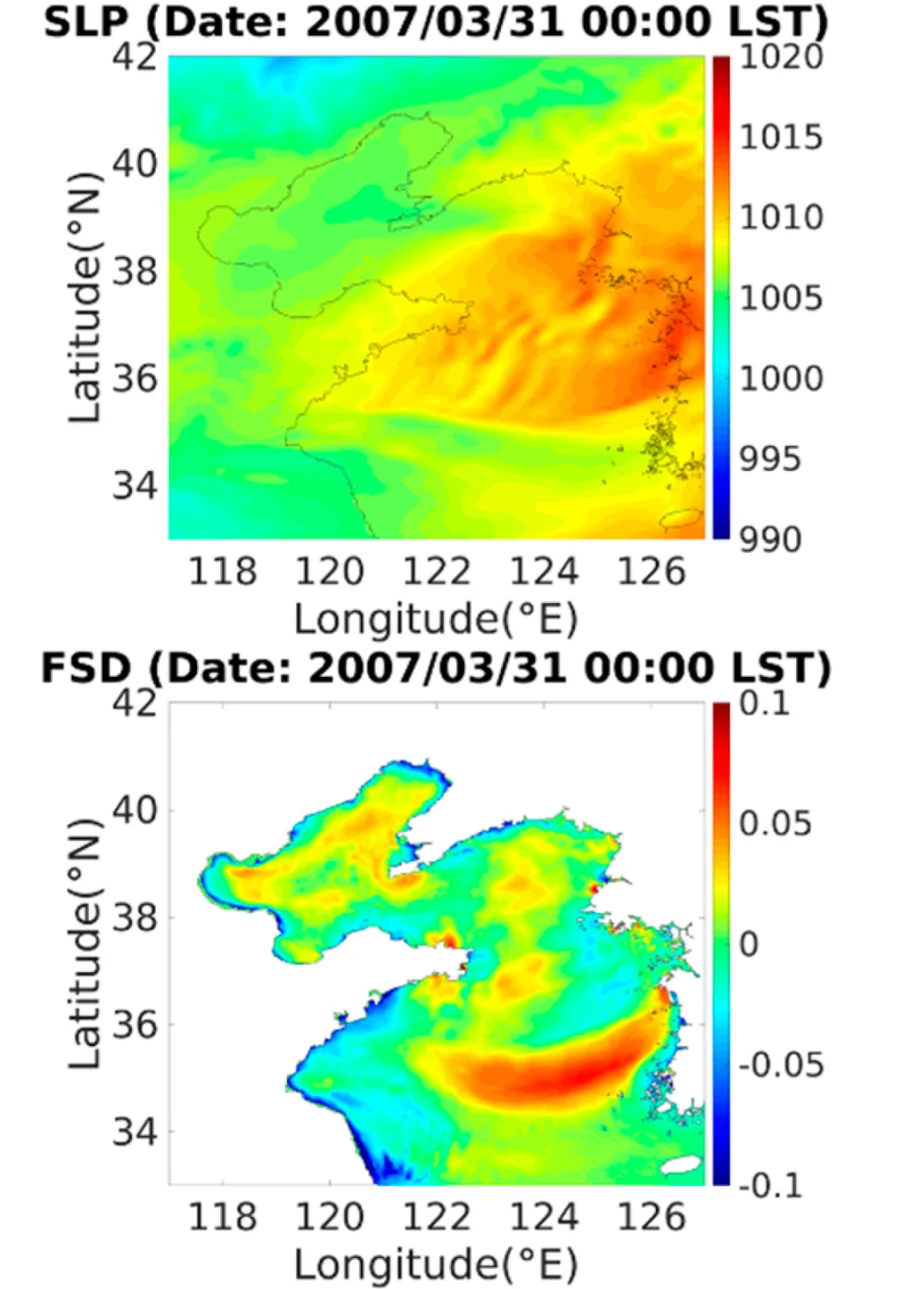
What you will do
- Identify meteotsunamis in sea-level records from tide gauges along the Chilean coast and in atmospheric pressure measurements.
- Simulate the atmospheric disturbance of each event with MPAS (opens in a new tab), a mesoscale atmospheric model.
- Force the hydrodynamic model ADCIRC (opens in a new tab) with that pressure and wind to simulate how the wave is generated and propagates to the coast.
- Validate the simulations against the pressure and sea-level measurements.
- Compare the amplification across bays and harbors, and relate it to the shape of the shelf and the coastline.
Requirements
Programming in Python (or the will to learn it), an interest in tsunamis, meteorology and numerical modeling, and reading in English.
Reading to get started
- Carvajal, M., Contreras-López, M., Winckler, P. and Sepúlveda, I. (2017). Meteotsunamis occurring along the southwest coast of South America during an intense storm. Pure and Applied Geophysics, 174, 3313–3323. doi:10.1007/s00024-017-1584-0 (opens in a new tab)
- Heo, K.-Y., Yoon, J.-S., Bae, J.-S. and Ha, T. (2019). Numerical modeling of meteotsunami–tide interaction in the eastern Yellow Sea. Atmosphere, 10(7), 369. doi:10.3390/atmos10070369 (opens in a new tab)
- Monserrat, S., Vilibić, I. and Rabinovich, A. B. (2006). Meteotsunamis: atmospherically induced destructive ocean waves in the tsunami frequency band. Natural Hazards and Earth System Sciences, 6, 1035–1051. doi:10.5194/nhess-6-1035-2006 (opens in a new tab)