
Extend SWEpy to spherical coordinates for far-field tsunami simulations
- Campus: Casa Central campus
- Posted on
Extending SWEpy to spherical coordinates for far-field tsunamis
SWEpy, developed by our group, is an open-source, GPU-accelerated finite volume solver in Python for the Saint-Venant equations, used to simulate tsunamis, floods and dam breaks. It currently works in Cartesian coordinates, which is fine for near-field tsunamis and dam breaks, where distances are short and the Earth's curvature is negligible. For far-field tsunamis, such as those that cross an ocean, planar coordinates introduce errors in arrival times and wave amplitudes, and that affects forecasts.
In this thesis you will extend the model to spherical coordinates to account for the Earth's curvature. This will make global simulations more accurate and support more reliable early warning systems, especially for exposed regions such as Chile.
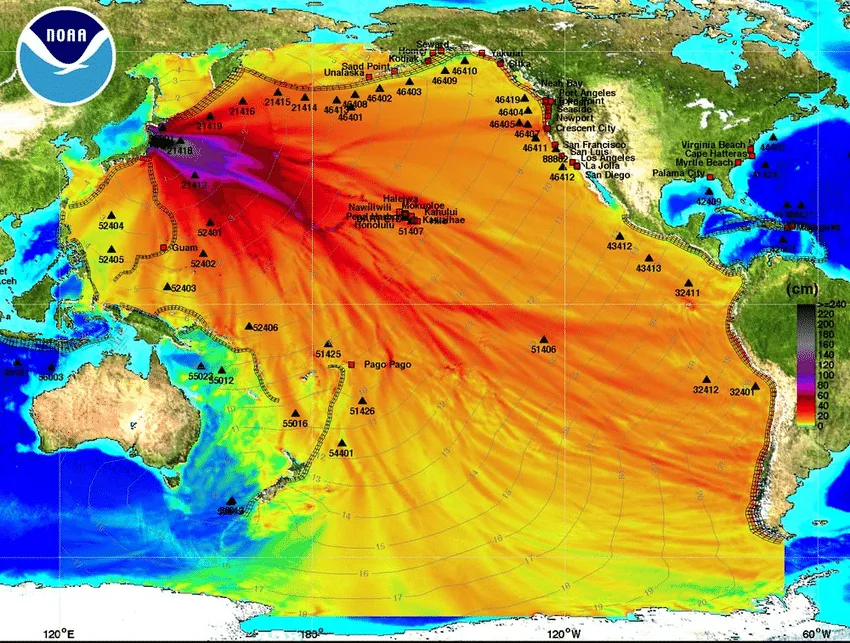
Tsunami propagation forecast computed with the MOST model. Colors show the maximum computed tsunami amplitude (in cm) during 24 hours of propagation, and black contours show the computed arrival time.
Source: Titov, Vasily & Bernard, E. & Arcas, Diego & Chamberlin, Chris & Moore, Christopher & Tang, Liujuan. (2011). March 11, 2011 Tohoku-Japan tsunami: Lessons from forecast assessment.
Objectives
- Review and modify the SWEpy numerical scheme (central-upwind, WENO, Runge-Kutta) for spherical coordinates, adding the Earth's curvature terms.
- Implement the extension in Python with GPU support (CUDA), optimized for large domains.
- Validate the extended model with benchmark cases such as the 2010 Maule tsunami (near field) and trans-Pacific events (far field), comparing arrival times and wave heights.
- Assess the reduction in propagation errors and propose how to use it in real tsunami forecasting.