
Exploring the consistency of extreme hydrometeorological records in Chile's monitoring network and their propagation into hydrological estimates
- Campus: Casa Central campus, San Joaquín campus
- Time commitment: Full-time
- Posted on
Supervisors: Álvaro Ossandón (USM) and Eduardo Muñoz-Castro (SLF–ETH)
Motivation
The aim of this work is to assess the quality and consistency of hydrometeorological records in Chile, with emphasis on extreme precipitation, temperature and streamflow events. Through quality-control procedures and statistical tools for temporal and spatial analysis, the thesis seeks to identify potentially inconsistent records, evaluate their relationship with different hydroclimatic conditions and quantify how these inconsistencies propagate across time scales. It also seeks to develop an integrated methodology to assess the reliability of extreme records that accounts for the climatic and geographic heterogeneity of the country. In particular, the thesis addresses the following questions:
- How consistent are extreme hydrometeorological records in Chile, and how does their reliability vary across stations, variables and hydroclimatic conditions?
- How do inconsistencies identified at the hourly scale propagate to longer time scales, and what effects do they have on hydrometeorological statistics?
- Which criteria and procedures can be integrated into a systematic and reproducible methodology to assess the quality and reliability of hydrometeorological records?
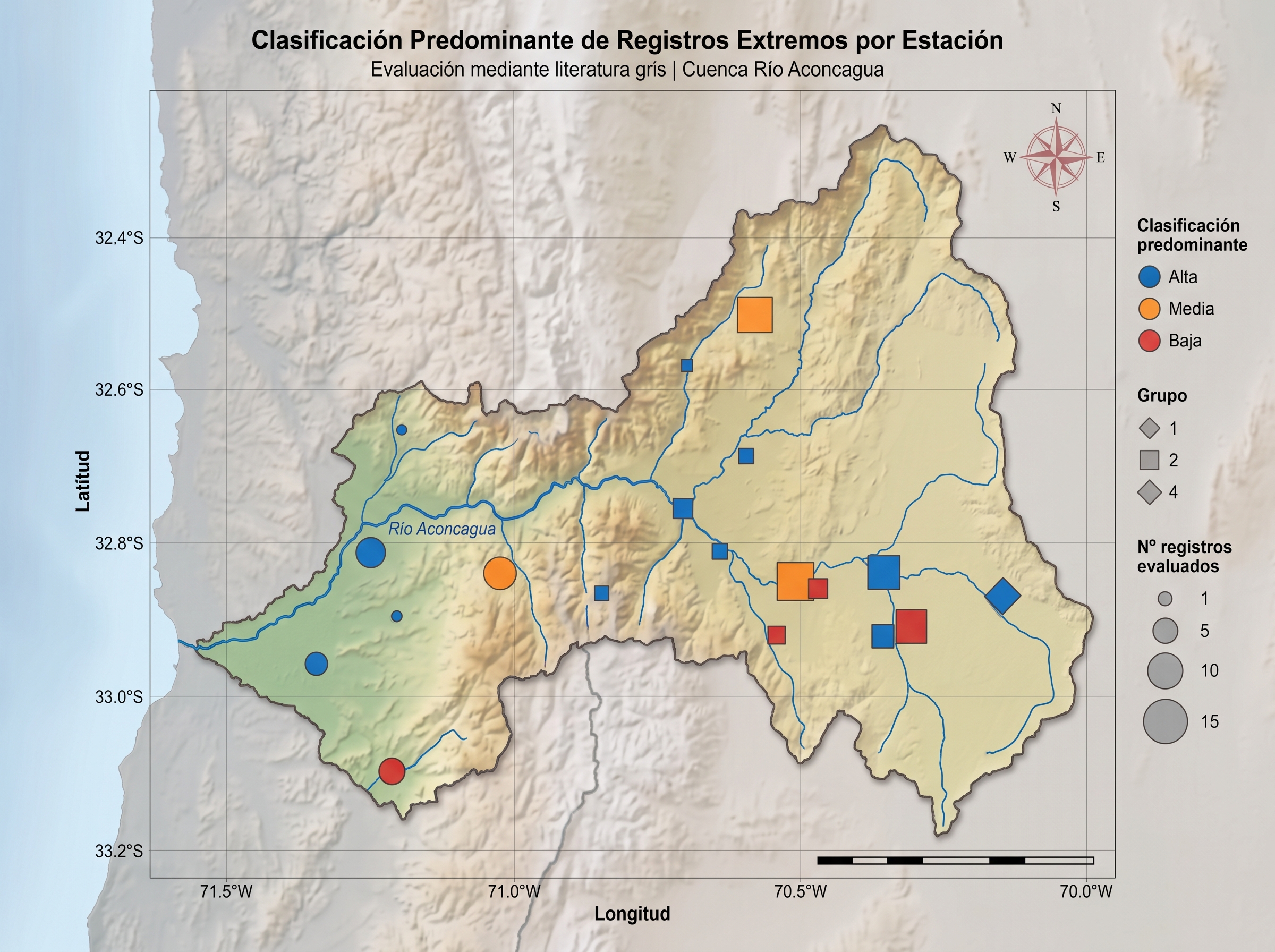
Figure 1: Example of a reliability assessment of extreme hourly precipitation records from the DGA network in the Aconcagua River basin: predominant level of documentary support by station. Source: Figure adapted with AI from Gallardo (2026).
This research will contribute reproducible tools to assess the reliability of observations and support their use in hydrological studies, characterization of extremes, analysis of variability and climate change, and assessment of hydroclimatic risks.
Requirements
Ideally, students should have programming skills in Matlab, R or Python (or plenty of enthusiasm to acquire them!) and be able to read English.
Selected candidates must apply to the corresponding master's program within the deadlines set by the university.