
Assessing climate change effects on probable maximum precipitation (PMP) with the WRF model
- Campus: Casa Central campus
- Posted on
Estimating probable maximum precipitation (PMP) with WRF under climate change
Probable maximum precipitation (PMP) is a parameter commonly used in the hydraulic design of critical infrastructure such as dams, reservoirs and drainage systems. It represents the theoretical maximum possible precipitation and is used to ensure safety under extreme scenarios.
This master's thesis extends methods from the group's publications, which use physically based numerical models such as WRF to maximize historical precipitation in Andean basins, by adding the effects of climate change. You will use WRF, a physically based model for high-resolution atmospheric simulations, as the main tool for dynamical downscaling: you will perturb storms with CMIP5 data (thermodynamic and dynamic anomalies under different RCPs) and simulate how global warming intensifies PMP through higher atmospheric moisture and changes in storm efficiency and dynamics. The focus is on PMP as a design parameter in exposed regions of Chile, such as the central Andes, and on informing infrastructure design standards for future scenarios.
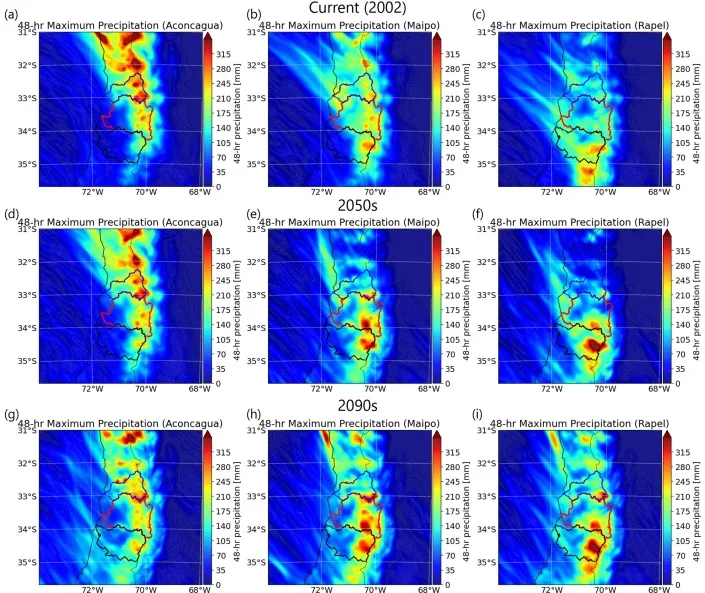
Spatial distribution of precipitation during the 48-hour maximum for each basin and each warming scenario.
Source: Yusuke Hiraga, Ryotaro Tahara, Joaquin Meza, A methodology to estimate Probable Maximum Precipitation (PMP) under climate change using a numerical weather model, Journal of Hydrology, Volume 652, 2025, 132659, ISSN 0022-1694, https://doi.org/10.1016/j.jhydrol.2024.132659 (opens in a new tab).
Objectives
- Adapt existing physically based WRF models to include CMIP5 climate perturbations (for example, downscaling ensembles under different scenarios).
- Simulate climate change effects on historical storms with WRF, maximizing precipitation with physical techniques such as ABCS and assessing super-CC scaling.
- Recompute PMP, as a standard hydraulic design parameter, for specific basins.
- Assess the impact on hydraulic design parameters and propose climate adaptation recommendations for Chile.