
Speed up flood forecasts with GPU snow energy balance models
- Campus: Casa Central campus
- Posted on
Coupling a snow energy balance model with SWEpy: CUDA reimplementation for flood simulation
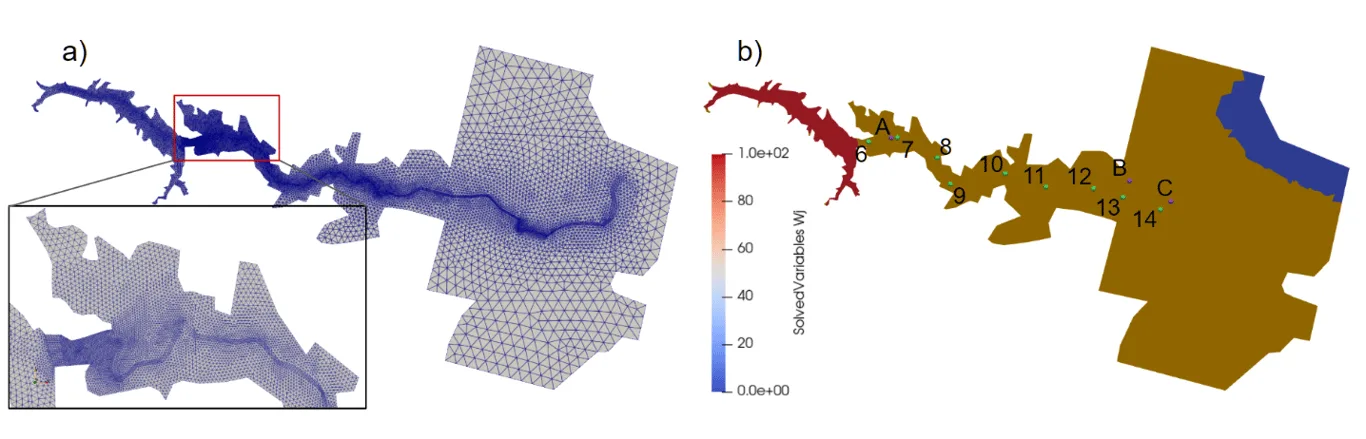
This master's thesis aims to improve flood forecasting in mountain regions, where snow plays a key role in the hydrological cycle. The starting point is an initial Python version of an energy balance model that estimates snow accumulation and melt from factors such as solar radiation, temperature and wind. The main challenge is to couple this model with SWEpy, the UTFSM Hydrology Group's open-source software that solves the Saint-Venant equations to simulate floods, dam breaks and tsunamis.
The current code runs on the CPU and is highly parallelizable, so you will reimplement its key parts in CUDA, NVIDIA's parallel computing platform for GPU programming, and move the computations to the GPU to cut computing time. This will allow faster and more accurate simulations at large scales, useful for real-time forecasting or for studying climate change in regions such as the Chilean Andes.
Objectives
- Adapt and couple the snow energy balance model with SWEpy.
- Reimplement the code in CUDA to parallelize operations on the GPU and improve performance over the CPU version.
- Validate the coupled model with real cases (for example, data from snow-fed basins in Chile) and assess its accuracy in flood scenarios.
- Explore applications such as flood forecasting in mountain areas under climate change scenarios.